Buhari does not have to love the Igbo
There has been a spate of criticism
and worry from the Eastern end complaining that President Buhari’s appointments
thus far have been lopsided, and has generally ignored the South-Eastern Igbo
in large part, and the minorities of the South, to some extent.
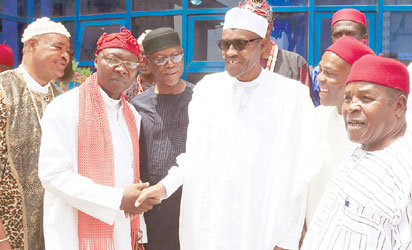
APC Presidential Campaign Candidate,
General Muhammadu Buhari, (middle) flanked by APC National Chairman, All
Progressive Congress (APC), Chief John Odigie Oyegun, APC Chieftain and former
Goverinor, Chief Ogbonnaya Ono, Eze Ndi Igbo Suleja, Amb (Dr.) Igwe Collins
Chibueze Okoli, Uche Eginti Eze Udo, President General Igbo delegates Assembly
(IDA) of the19 Northern States, Chief Damian Sunny Inyamah and others adopt GEN
Muhammadu Buhari for 2015 Presidency at the APC Presidential Campaign office in
Abuja. File Photo
The president’s profile of
appointments to key military, security, and corporate institutional positions
has tended more to be from the North. In a sense, the President has made the
office of the president, the face of his administration, a profoundly regional
one. The most disturbing to most people was the quick overturning of the
appointment of Mr. Nwabueze C. Obi, as the acting MD of the National Maritime
and Safety Agency, NIMASA, replaced with Mr. Haruna Jauro in quick order on the
orders of the president.
There is on the surface, a very
clearly regionalist bent in the president’s appointments so far, which prompted
Dr. Ezeife, reportedly, to snap at the president’s appointment of Dr. Ibe
Kachikwu as the new MD of the NNPC – the first of the president’s Igbo
appointees. “It is not enough!” Dr. Ezeife says. In a multi-ethnic state, such
as Nigeria, with a history of distrust, people have come to regard familiar
faces and familiar names they can identify as the basis for securing group
interests.
There is very little doubt that the
Igbo are a very robust group of Nigerians with their own sense of a strategic
interest, and anyone who ignores the Igbo does so at really great risks. I feel
certain that President Buhari knows this too. The Igbo have proven precedence
of action, once they choose to create synergy, and common cause. And their
impact could be devastating. I will cite four historical examples.
Between 1895 and 1930, with British
colonial forays into Africa late in the 19th century, the Igbo put up one of
the toughest resistances against British colonization in Africa. While the Igbo
fought, some of its neighbors fell in quick order.
For instance, in January 1903,
twenty four British officers led a column of 700 African soldiers of the new
West African Frontier Force, many of them Hausa, fresh from the Ashanti
campaigns, and marched on Kano, and defeated it at the battle of Bebedji. The
Emir of Kano, Aliyu, was in flight, while his brother, Muhammed Abbas was
installed as a British puppet. Emir Aliyu was soon captured, exiled, and locked
up in the British military garrison in Lokoja where he died in 1926. The
British defeat and killing of Sultan Attahiru, and the Magajin of Keffi, among
many in Burmi on July 27, 1903, marked the formal end of the Caliph’s
resistance in Sokoto against the British.
Southwards, exhausted by internal
rife and the hundred-year civil war following the collapse of Oyo, the Yoruba
historian Johnson wrote that it was the Yoruba Obas themselves who wrote and
invited the British to come and colonize Yoruba land. Oba Ovoranwen of Benin
was quickly defeated by the British and exiled to Calabar, where he too died in
exile. But the British fought the Igbo for thirty years, in five campaigns from
1900to 1930, until the British forced the High Priest, Eze Nri Obalike, to
appear at the Awka Courts in 1930. Historians like Don Ohadike have written
eloquently about the Ekumeku movement and the Igbo use of guerrilla warfare
against the British.
Meanwhile, the previous year in
1929, Igbo women had driven away the colonial warrant chiefs, imposed on the
Igbo by the British. All that prompted, in an attempted to understand the Igbo,
the British government under the Colonial Governor-General, Sir Ralph Cameron,
to send a series of Anthropologists to study the Igbo. One of them, Sylvia
Leith-Ross, came in 1930, and wrote the book, Among African Women, with the
preface by Lord Lugard. She noted thus in her book about the Igbo: “these
people are not intimidated by us, and are rather amused by us. They watch us
and learn quickly what we know. God help us the day they climb the ladder.”
By the 1930s, following their work
as technicians, tradesmen, mid-level clerks in commercial and government jobs,
and artisans helping to lay the North-South Rail lines, the Igbo, had fanned
across and settled in what is now modern Nigeria.
From 1937-1957 they had enough
national density to mobilize and rally round Dr. Azikiwe, and were the arrowheads
in the anti-colonial nationalist movement that forced the British colonialists
out of Nigeria. By 1967, finding Nigeria no longer suitable for their
collective interest and protection, they staged an exit and declared their own
state of Biafra. The Igbo remain the only one of the major groups in Nigeria to
mobilize an army, create an independent state, and fight in defence of their
interests; and they have the capacity to do so again if they feel themselves,
and their collective interests threatened. For three years, they fought, and in
1970, exhausted and surrounded, they agreed to a negotiated end, and returned
to Nigeria.
But I do know that they did not feel
themselves defeated, as elements of the S Brigade under Tim Onwuatuegwu, among
whom my uncle, now a Professor of Geophysics, had been trained and prepared to
activate the guerilla phase of the war nation-wide should there be need to
defend the Igbo in 1970. Nigerians should thank General Gowon, and the late MD
Yusuf, who made it part of his policy, to absorb key members of the Biafran
Organization of Freedom Fighters, into the Nigerian Intelligence Services to
tamp down that possibility.
The Nigerian government knew that
the Igbo were the only part of Nigeria that had highly trained combatants with
field experience who had circulated into civilian life as traders, artisans,
students, university professors, civil servants, teachers, and other
professionals, and you do not mess with people like that. Nigeria gave the Igbo
their due up till the middle of the 1980s. I have outlined these simply to
suggest that President Buhari, himself a combatant of the last war, knows the
Igbo, and that he would not take Igbo interest for granted.
General Sam Momah, once Buhari’s
Principal Staff Officer has reminded the Igbo that some of the President’s best
friends are Igbo. I do believe him. I also think that this president has a
right, indeed an obligation to his office, to choose whomsoever he likes, from
any part of Nigeria, to do the job. Fair representation is fantastic. But the
president is possibly signaling an important message, that these ethnic or
regional considerations, should not be at the detriment of competence and
trust. The people he has chosen so far, seem competent. All we need to do is
keep them under scrutiny. What the Igbo should campaign for is that no matter
who occupies a public office, no Nigerian, Igbo or not, must suffer
discrimination, or be the subject of selective targeting, in the exercise of
the function of any office. Nice as it might seem to see a familiar face in the
picture of the president’s team, I should prefer that the president be pushed
more in the direction of influencing more direct federal investments in Igbo
land, to alleviate the problems of the high unemployment rate in the region.
The president does not need to love
the Igbo, but he must assure them just and equal protection in his government
in terms of direct benefit to their wider number. Not to do that will certainly
rouse the Igbo to seek justice by all means necessary.
Besides, President Buhari will not
be the president forever, and the precedent he sets today, might mean, that
whoever becomes president after him, may as well choose his key staff from his
region, for as long as they satisfy the criteria of competence, integrity, and
fairness in the execution of their jobs. The Igbo should therefore be patient,
and circumspect on this matter of the president’s political appointments: let
him do his job, with the men and women he can trust to do it.
Buhari does not have to love the Igbo
By Obui Nwakanma
There has been a spate of criticism and worry from the Eastern end complaining that President Buhari’s appointments thus far have been lopsided, and has generally ignored the South-Eastern Igbo in large part, and the minorities of the South, to some extent.
 The president’s profile of appointments to key military, security,
and corporate institutional positions has tended more to be from the
North. In a sense, the President has made the office of the president,
the face of his administration, a profoundly regional one. The most
disturbing to most people was the quick overturning of the appointment
of Mr. Nwabueze C. Obi, as the acting MD of the National Maritime and
Safety Agency, NIMASA, replaced with Mr. Haruna Jauro in quick order on
the orders of the president.
The president’s profile of appointments to key military, security,
and corporate institutional positions has tended more to be from the
North. In a sense, the President has made the office of the president,
the face of his administration, a profoundly regional one. The most
disturbing to most people was the quick overturning of the appointment
of Mr. Nwabueze C. Obi, as the acting MD of the National Maritime and
Safety Agency, NIMASA, replaced with Mr. Haruna Jauro in quick order on
the orders of the president.
There is on the surface, a very clearly regionalist bent in the president’s appointments so far, which prompted Dr. Ezeife, reportedly, to snap at the president’s appointment of Dr. Ibe Kachikwu as the new MD of the NNPC – the first of the president’s Igbo appointees. “It is not enough!” Dr. Ezeife says. In a multi-ethnic state, such as Nigeria, with a history of distrust, people have come to regard familiar faces and familiar names they can identify as the basis for securing group interests.
There is very little doubt that the Igbo are a very robust group of Nigerians with their own sense of a strategic interest, and anyone who ignores the Igbo does so at really great risks. I feel certain that President Buhari knows this too. The Igbo have proven precedence of action, once they choose to create synergy, and common cause. And their impact could be devastating. I will cite four historical examples.
Between 1895 and 1930, with British colonial forays into Africa late in the 19th century, the Igbo put up one of the toughest resistances against British colonization in Africa. While the Igbo fought, some of its neighbors fell in quick order.
For instance, in January 1903, twenty four British officers led a column of 700 African soldiers of the new West African Frontier Force, many of them Hausa, fresh from the Ashanti campaigns, and marched on Kano, and defeated it at the battle of Bebedji. The Emir of Kano, Aliyu, was in flight, while his brother, Muhammed Abbas was installed as a British puppet. Emir Aliyu was soon captured, exiled, and locked up in the British military garrison in Lokoja where he died in 1926. The British defeat and killing of Sultan Attahiru, and the Magajin of Keffi, among many in Burmi on July 27, 1903, marked the formal end of the Caliph’s resistance in Sokoto against the British.
Southwards, exhausted by internal rife and the hundred-year civil war following the collapse of Oyo, the Yoruba historian Johnson wrote that it was the Yoruba Obas themselves who wrote and invited the British to come and colonize Yoruba land. Oba Ovoranwen of Benin was quickly defeated by the British and exiled to Calabar, where he too died in exile. But the British fought the Igbo for thirty years, in five campaigns from 1900to 1930, until the British forced the High Priest, Eze Nri Obalike, to appear at the Awka Courts in 1930. Historians like Don Ohadike have written eloquently about the Ekumeku movement and the Igbo use of guerrilla warfare against the British.
Meanwhile, the previous year in 1929, Igbo women had driven away the colonial warrant chiefs, imposed on the Igbo by the British. All that prompted, in an attempted to understand the Igbo, the British government under the Colonial Governor-General, Sir Ralph Cameron, to send a series of Anthropologists to study the Igbo. One of them, Sylvia Leith-Ross, came in 1930, and wrote the book, Among African Women, with the preface by Lord Lugard. She noted thus in her book about the Igbo: “these people are not intimidated by us, and are rather amused by us. They watch us and learn quickly what we know. God help us the day they climb the ladder.”
By the 1930s, following their work as technicians, tradesmen, mid-level clerks in commercial and government jobs, and artisans helping to lay the North-South Rail lines, the Igbo, had fanned across and settled in what is now modern Nigeria.
From 1937-1957 they had enough national density to mobilize and rally round Dr. Azikiwe, and were the arrowheads in the anti-colonial nationalist movement that forced the British colonialists out of Nigeria. By 1967, finding Nigeria no longer suitable for their collective interest and protection, they staged an exit and declared their own state of Biafra. The Igbo remain the only one of the major groups in Nigeria to mobilize an army, create an independent state, and fight in defence of their interests; and they have the capacity to do so again if they feel themselves, and their collective interests threatened. For three years, they fought, and in 1970, exhausted and surrounded, they agreed to a negotiated end, and returned to Nigeria.
But I do know that they did not feel themselves defeated, as elements of the S Brigade under Tim Onwuatuegwu, among whom my uncle, now a Professor of Geophysics, had been trained and prepared to activate the guerilla phase of the war nation-wide should there be need to defend the Igbo in 1970. Nigerians should thank General Gowon, and the late MD Yusuf, who made it part of his policy, to absorb key members of the Biafran Organization of Freedom Fighters, into the Nigerian Intelligence Services to tamp down that possibility.
The Nigerian government knew that the Igbo were the only part of Nigeria that had highly trained combatants with field experience who had circulated into civilian life as traders, artisans, students, university professors, civil servants, teachers, and other professionals, and you do not mess with people like that. Nigeria gave the Igbo their due up till the middle of the 1980s. I have outlined these simply to suggest that President Buhari, himself a combatant of the last war, knows the Igbo, and that he would not take Igbo interest for granted.
General Sam Momah, once Buhari’s Principal Staff Officer has reminded the Igbo that some of the President’s best friends are Igbo. I do believe him. I also think that this president has a right, indeed an obligation to his office, to choose whomsoever he likes, from any part of Nigeria, to do the job. Fair representation is fantastic. But the president is possibly signaling an important message, that these ethnic or regional considerations, should not be at the detriment of competence and trust. The people he has chosen so far, seem competent. All we need to do is keep them under scrutiny. What the Igbo should campaign for is that no matter who occupies a public office, no Nigerian, Igbo or not, must suffer discrimination, or be the subject of selective targeting, in the exercise of the function of any office. Nice as it might seem to see a familiar face in the picture of the president’s team, I should prefer that the president be pushed more in the direction of influencing more direct federal investments in Igbo land, to alleviate the problems of the high unemployment rate in the region.
The president does not need to love the Igbo, but he must assure them just and equal protection in his government in terms of direct benefit to their wider number. Not to do that will certainly rouse the Igbo to seek justice by all means necessary.
Besides, President Buhari will not be the president forever, and the precedent he sets today, might mean, that whoever becomes president after him, may as well choose his key staff from his region, for as long as they satisfy the criteria of competence, integrity, and fairness in the execution of their jobs. The Igbo should therefore be patient, and circumspect on this matter of the president’s political appointments: let him do his job, with the men and women he can trust to do it.
There has been a spate of criticism and worry from the Eastern end complaining that President Buhari’s appointments thus far have been lopsided, and has generally ignored the South-Eastern Igbo in large part, and the minorities of the South, to some extent.
APC
Presidential Campaign Candidate, General Muhammadu Buhari, (middle)
flanked by APC National Chairman, All Progressive Congress (APC), Chief
John Odigie Oyegun, APC Chieftain and former Goverinor, Chief Ogbonnaya
Ono, Eze Ndi Igbo Suleja, Amb (Dr.) Igwe Collins Chibueze Okoli, Uche
Eginti Eze Udo, President General Igbo delegates Assembly (IDA) of the19
Northern States, Chief Damian Sunny Inyamah and others adopt GEN
Muhammadu Buhari for 2015 Presidency at the APC Presidential Campaign
office in Abuja. File Photo
There is on the surface, a very clearly regionalist bent in the president’s appointments so far, which prompted Dr. Ezeife, reportedly, to snap at the president’s appointment of Dr. Ibe Kachikwu as the new MD of the NNPC – the first of the president’s Igbo appointees. “It is not enough!” Dr. Ezeife says. In a multi-ethnic state, such as Nigeria, with a history of distrust, people have come to regard familiar faces and familiar names they can identify as the basis for securing group interests.
There is very little doubt that the Igbo are a very robust group of Nigerians with their own sense of a strategic interest, and anyone who ignores the Igbo does so at really great risks. I feel certain that President Buhari knows this too. The Igbo have proven precedence of action, once they choose to create synergy, and common cause. And their impact could be devastating. I will cite four historical examples.
Between 1895 and 1930, with British colonial forays into Africa late in the 19th century, the Igbo put up one of the toughest resistances against British colonization in Africa. While the Igbo fought, some of its neighbors fell in quick order.
For instance, in January 1903, twenty four British officers led a column of 700 African soldiers of the new West African Frontier Force, many of them Hausa, fresh from the Ashanti campaigns, and marched on Kano, and defeated it at the battle of Bebedji. The Emir of Kano, Aliyu, was in flight, while his brother, Muhammed Abbas was installed as a British puppet. Emir Aliyu was soon captured, exiled, and locked up in the British military garrison in Lokoja where he died in 1926. The British defeat and killing of Sultan Attahiru, and the Magajin of Keffi, among many in Burmi on July 27, 1903, marked the formal end of the Caliph’s resistance in Sokoto against the British.
Southwards, exhausted by internal rife and the hundred-year civil war following the collapse of Oyo, the Yoruba historian Johnson wrote that it was the Yoruba Obas themselves who wrote and invited the British to come and colonize Yoruba land. Oba Ovoranwen of Benin was quickly defeated by the British and exiled to Calabar, where he too died in exile. But the British fought the Igbo for thirty years, in five campaigns from 1900to 1930, until the British forced the High Priest, Eze Nri Obalike, to appear at the Awka Courts in 1930. Historians like Don Ohadike have written eloquently about the Ekumeku movement and the Igbo use of guerrilla warfare against the British.
Meanwhile, the previous year in 1929, Igbo women had driven away the colonial warrant chiefs, imposed on the Igbo by the British. All that prompted, in an attempted to understand the Igbo, the British government under the Colonial Governor-General, Sir Ralph Cameron, to send a series of Anthropologists to study the Igbo. One of them, Sylvia Leith-Ross, came in 1930, and wrote the book, Among African Women, with the preface by Lord Lugard. She noted thus in her book about the Igbo: “these people are not intimidated by us, and are rather amused by us. They watch us and learn quickly what we know. God help us the day they climb the ladder.”
By the 1930s, following their work as technicians, tradesmen, mid-level clerks in commercial and government jobs, and artisans helping to lay the North-South Rail lines, the Igbo, had fanned across and settled in what is now modern Nigeria.
From 1937-1957 they had enough national density to mobilize and rally round Dr. Azikiwe, and were the arrowheads in the anti-colonial nationalist movement that forced the British colonialists out of Nigeria. By 1967, finding Nigeria no longer suitable for their collective interest and protection, they staged an exit and declared their own state of Biafra. The Igbo remain the only one of the major groups in Nigeria to mobilize an army, create an independent state, and fight in defence of their interests; and they have the capacity to do so again if they feel themselves, and their collective interests threatened. For three years, they fought, and in 1970, exhausted and surrounded, they agreed to a negotiated end, and returned to Nigeria.
But I do know that they did not feel themselves defeated, as elements of the S Brigade under Tim Onwuatuegwu, among whom my uncle, now a Professor of Geophysics, had been trained and prepared to activate the guerilla phase of the war nation-wide should there be need to defend the Igbo in 1970. Nigerians should thank General Gowon, and the late MD Yusuf, who made it part of his policy, to absorb key members of the Biafran Organization of Freedom Fighters, into the Nigerian Intelligence Services to tamp down that possibility.
The Nigerian government knew that the Igbo were the only part of Nigeria that had highly trained combatants with field experience who had circulated into civilian life as traders, artisans, students, university professors, civil servants, teachers, and other professionals, and you do not mess with people like that. Nigeria gave the Igbo their due up till the middle of the 1980s. I have outlined these simply to suggest that President Buhari, himself a combatant of the last war, knows the Igbo, and that he would not take Igbo interest for granted.
General Sam Momah, once Buhari’s Principal Staff Officer has reminded the Igbo that some of the President’s best friends are Igbo. I do believe him. I also think that this president has a right, indeed an obligation to his office, to choose whomsoever he likes, from any part of Nigeria, to do the job. Fair representation is fantastic. But the president is possibly signaling an important message, that these ethnic or regional considerations, should not be at the detriment of competence and trust. The people he has chosen so far, seem competent. All we need to do is keep them under scrutiny. What the Igbo should campaign for is that no matter who occupies a public office, no Nigerian, Igbo or not, must suffer discrimination, or be the subject of selective targeting, in the exercise of the function of any office. Nice as it might seem to see a familiar face in the picture of the president’s team, I should prefer that the president be pushed more in the direction of influencing more direct federal investments in Igbo land, to alleviate the problems of the high unemployment rate in the region.
The president does not need to love the Igbo, but he must assure them just and equal protection in his government in terms of direct benefit to their wider number. Not to do that will certainly rouse the Igbo to seek justice by all means necessary.
Besides, President Buhari will not be the president forever, and the precedent he sets today, might mean, that whoever becomes president after him, may as well choose his key staff from his region, for as long as they satisfy the criteria of competence, integrity, and fairness in the execution of their jobs. The Igbo should therefore be patient, and circumspect on this matter of the president’s political appointments: let him do his job, with the men and women he can trust to do it.

No comments:
Post a Comment